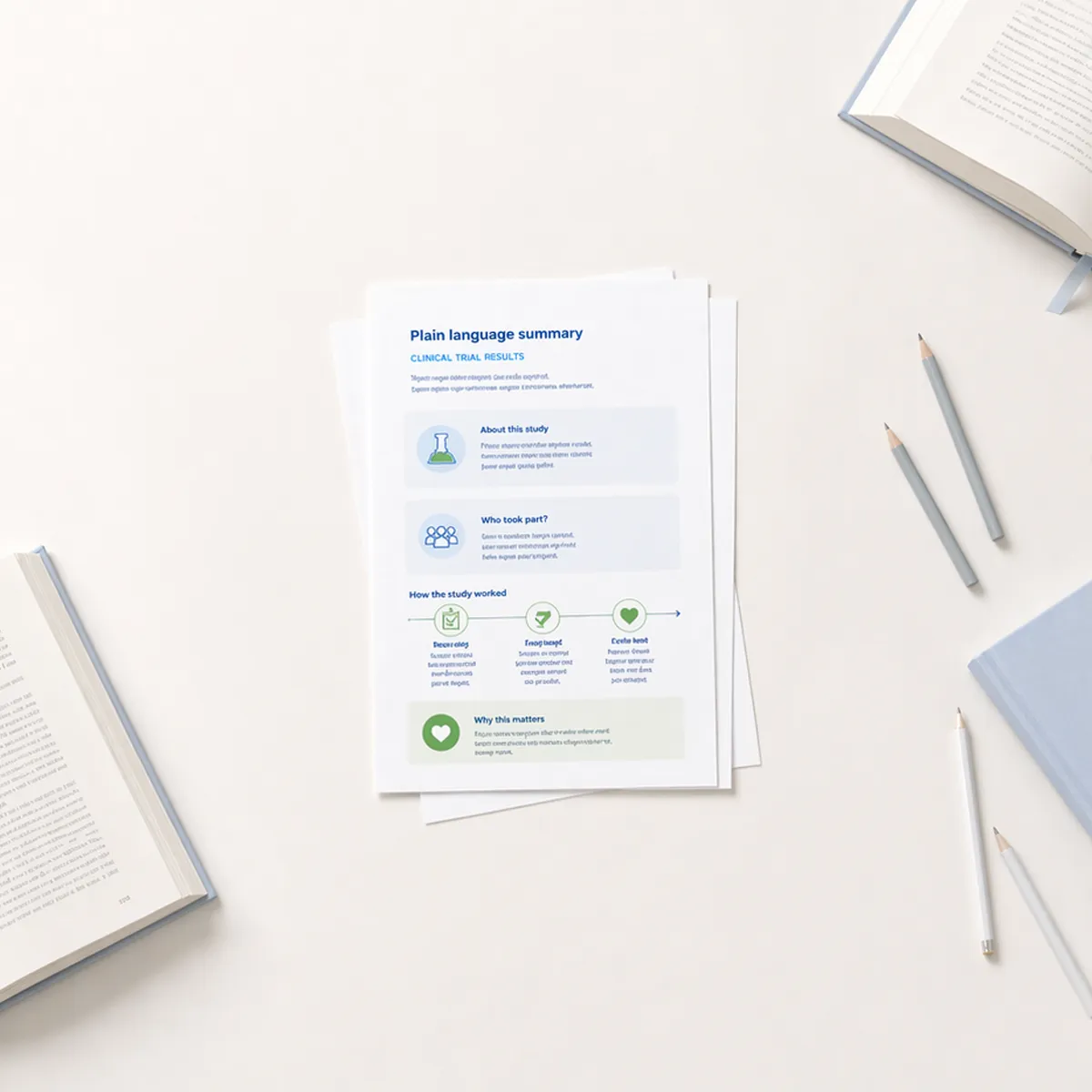
Plain language summaries of clinical trial results explain a study’s purpose, who took part, what treatments were studied, side effects, and the results in language that people without a medical or scientific background can understand.
But a clear PLS depends on more than the words on the page. The layout, reading order, and visuals affect how easily someone can follow and understand the information.
What is a plain language summary?
A plain language summary, or PLS, explains clinical trial results in clear language. It is written for readers with no medical or scientific background, at an 8th grade reading level.
It may be read by study participants, caregivers, patient advocates, and healthcare professionals. The goal is to share study results in a way that's easier to read, navigate, and understand.
A PLS explains why a study was done, who took part, what study medicine participants received, side effects, and what the results mean. These documents are also commonly referred to as plain language summaries of clinical trial results. They help make study findings understandable to people beyond scientific and medical audiences.
What should a clinical trial plain language summary include?
A plain language summary should give readers enough information to understand the study and its main findings without needing specialist knowledge. This usually includes why the study was conducted, who participated, what treatments or interventions were studied, what researchers found, what side effects occurred, and what the results mean.
How that information is organized matters, too. Readers should be able to find key information quickly and understand how each part of the study connects to the next.
Words + design = plain language
When we think about plain language the first thing that comes to mind is words. And words set the foundation, but design carries much of the weight.
A document’s first impression can influence whether someone wants to keep reading. Will a dense, disorganized layout feel inviting? Will it feel trustworthy?
According to the ISO plain language standard, word choice accounts for only 7% of what makes a communication clear. The rest is structure and design.
PLS design needs to support the way people read, search, compare, and review information. It should also consider how people respond to structure. Consistency can reduce stress by creating a sense of predictability and security. Clean, organized layouts can also reduce mental fatigue.
What makes a PLS easier to use
A usable PLS gives readers a clear path through the information.
Headings should help people understand where they are, whether or not they use assistive technology. Sections should follow a logical order, and important details should be easy to find and understand. White space gets a lot of attention for good reason. It supports reading flow, reduces visual fatigue, and gives the layout room to breathe.
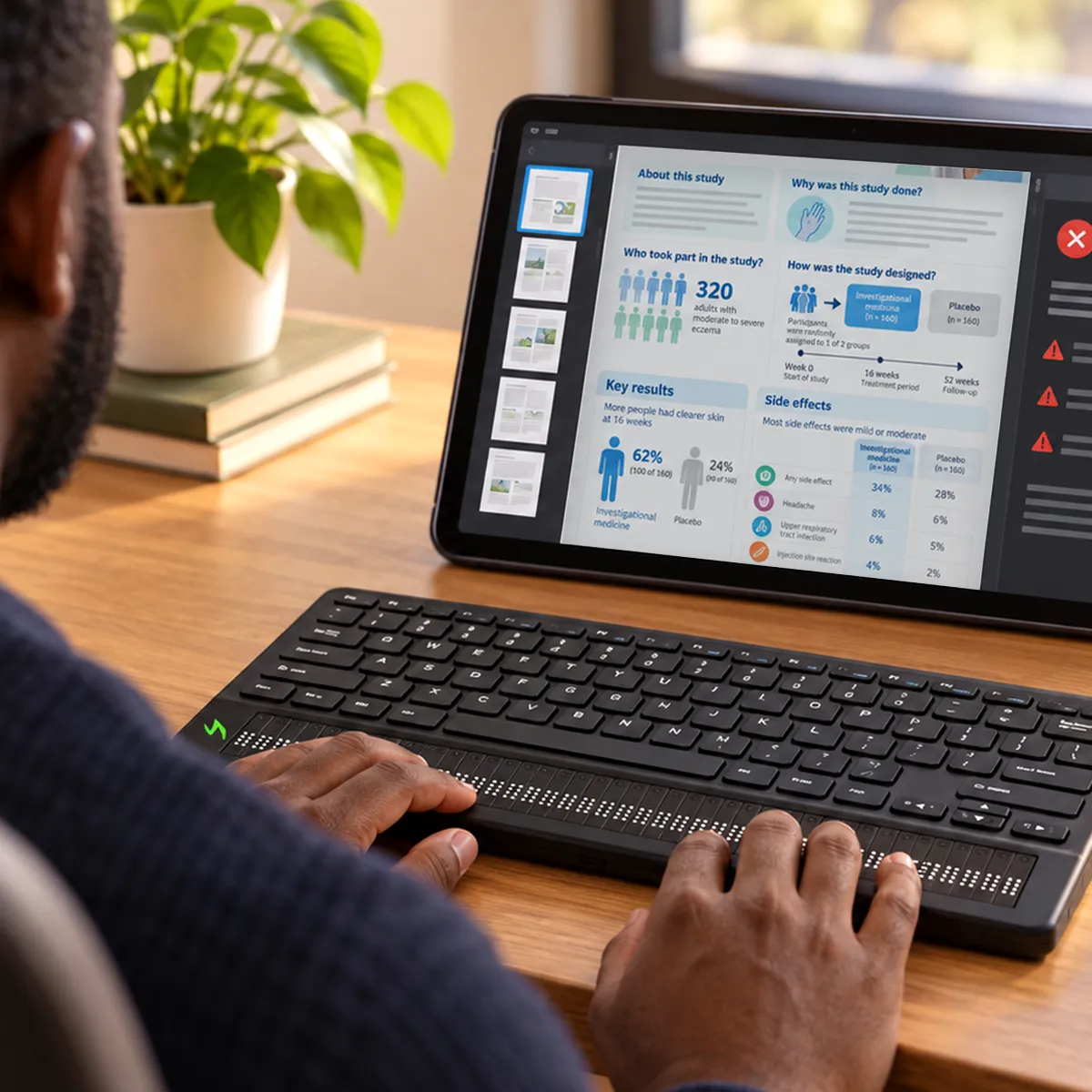
Tables and visuals also need careful attention. A study design graphic should explain the flow of the study clearly. Side effects tables should help readers compare information easily.
Tables need special care
Even though it is the simplest element to design, I consider tables one of the hardest parts of a clinical trial summary.
They include study groups, side effects, numbers, and percentages. Sometimes even explanatory notes. If the table is too dense and complex, confusion will increase. Getting lost in a table is real.
Tables need to be designed for both visual reading and screen reader navigation. Clear headings and simple grouping can make a major difference.
Why accessibility needs structure
A document’s structure affects how people move through the information, especially when they use a screen reader or other assistive technology. Headings, reading order, links, tables, and alternative text matter.
A well-planned layout can support clearer navigation and make the final PDF review process less fragile, because the content has been organized with accessibility in mind from the start.
Design support for plain language summaries
Some teams write plain language summaries in-house and need design support. That’s the work I do. I provide design and accessibility support for plain language summaries of clinical trial results, including individual PLS layouts, reusable templates, accessibility setup, and PDF remediation.
I design plain language summaries, lay protocol synopses, and health literacy materials for clinical research and healthcare communication.
To see how I can help, visit my services page.
A layout system for PLS teams
Some sponsors and research teams need a structured starting point they can use across studies.
My PLS layout system was created for sponsors and research organizations that want a more consistent foundation. It includes reusable layouts for core PLS sections, study design graphics, side effects tables, callouts, and visual elements.
The system is designed to support clearer reading order, screen reader navigation, and a more consistent workflow.
Visit my health literacy store to learn more and get in touch.
The bottom line
A plain language summary should help people easily understand what happened in a clinical trial. That depends on both the writing and how the information is structured and designed.
When structure is planned early, the summary is easier to read, understand, navigate, and produce consistently.